
NASA's Perseverance rover has been exploring Jezero Crater on Mars since February 2021, searching for signs of ancient microbial life, characterizing the region's geology and climate history, and collecting rock samples for a future return to Earth. It is the largest and most advanced rover NASA has ever sent to another planet.
This page tracks Perseverance's real position and distance driven using NASA's own published telemetry — the same data rendered live on SatFleet Live's interactive Mars map, alongside the rover's complete real driving trail.
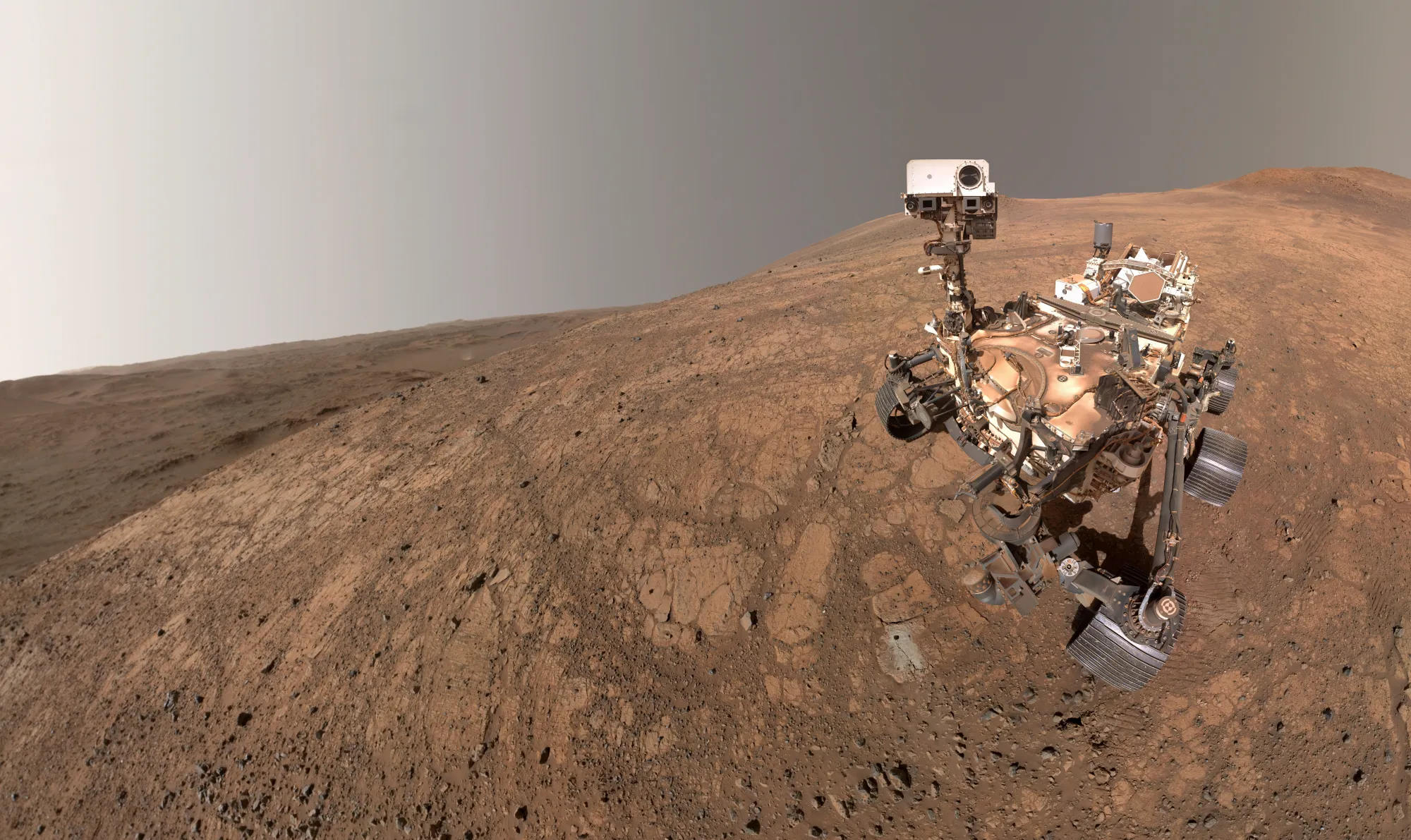
Quick Facts
| Mission name | Mars 2020 |
| Agency | NASA / Jet Propulsion Laboratory (JPL) |
| Launch | July 30, 2020, from Cape Canaveral Space Launch Complex 41 |
| Landing | February 18, 2021, Jezero Crater, Mars |
| Landing site | 18.4447°N, 77.4508°E — Jezero Crater, an ancient river delta and lakebed |
| Dimensions | Approx. 3 m long, 2.7 m wide, 2.2 m tall |
| Power source | Multi-Mission Radioisotope Thermoelectric Generator (MMRTG) |
| Mission status | Active, ongoing surface operations |
| Companion aircraft | Ingenuity Mars Helicopter (mission concluded January 2024) |
How This Live Data Works
The figures at the top of this page are not estimated or simulated. NASA publishes Perseverance's driving telemetry directly — including its position and cumulative distance driven — and SatFleet Live reads this data automatically to keep both this page and the interactive Mars map up to date. There is no manual updating involved; as the rover drives, the numbers here update to match.
On the Mars map, this same data is rendered as a real driving trail overlaid on true Mars surface imagery, alongside Curiosity, active orbiters, and the planet's moons, Phobos and Deimos.
Mission Objectives
Perseverance's mission is built around four primary goals. The first is astrobiology: searching for preserved signs of ancient microbial life in rock formed in environments that may once have been habitable. Jezero Crater was selected specifically for this purpose — orbital data showed clear evidence of ancient water activity and a well-preserved river delta.
The second is geology: characterizing the rock record left behind at the landing site to understand the region's history. The third is studying past climate, reconstructing what Mars' environment and habitability looked like billions of years ago.
The fourth objective is unique to this mission: Perseverance is the first spacecraft to collect and cache Martian rock and regolith samples, sealing them in tubes and depositing them on the surface for potential retrieval by a future mission that would return them to Earth for detailed laboratory analysis — something no orbiter or rover instrument can replicate remotely.
Perseverance also tests technology for future human exploration of Mars, including in-situ resource utilization — demonstrated through its now-complete MOXIE experiment, which produced oxygen from the Martian atmosphere.
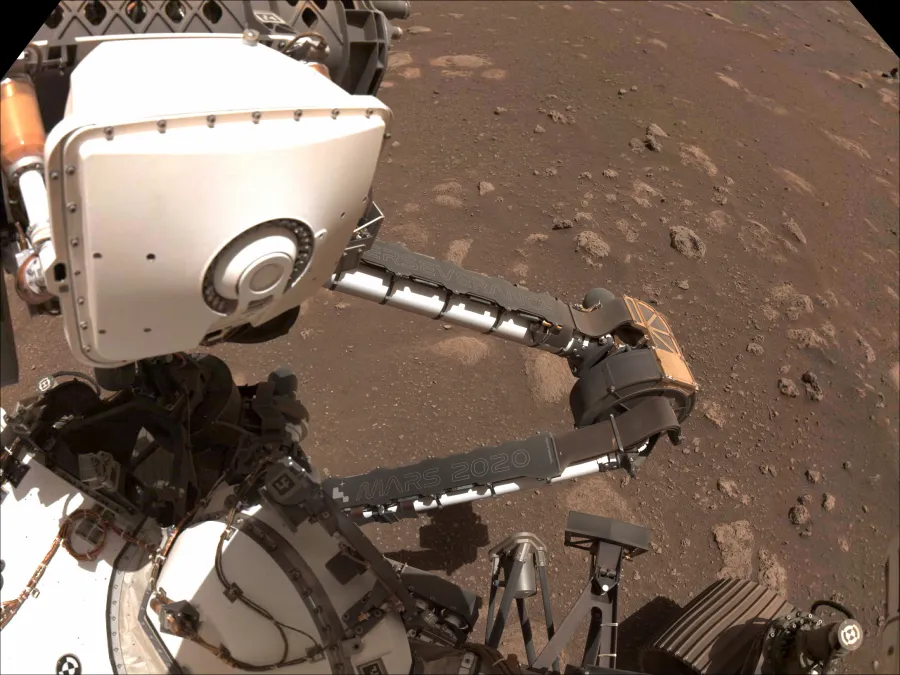
The Seven Science Instruments
Ingenuity: The First Aircraft on Another World
Perseverance carried the Ingenuity Mars Helicopter, a technology demonstration originally designed for just five experimental flights over 30 days. In April 2021, Ingenuity achieved the first powered, controlled flight by an aircraft on another planet — a milestone comparable to the Wright brothers' first flight on Earth.
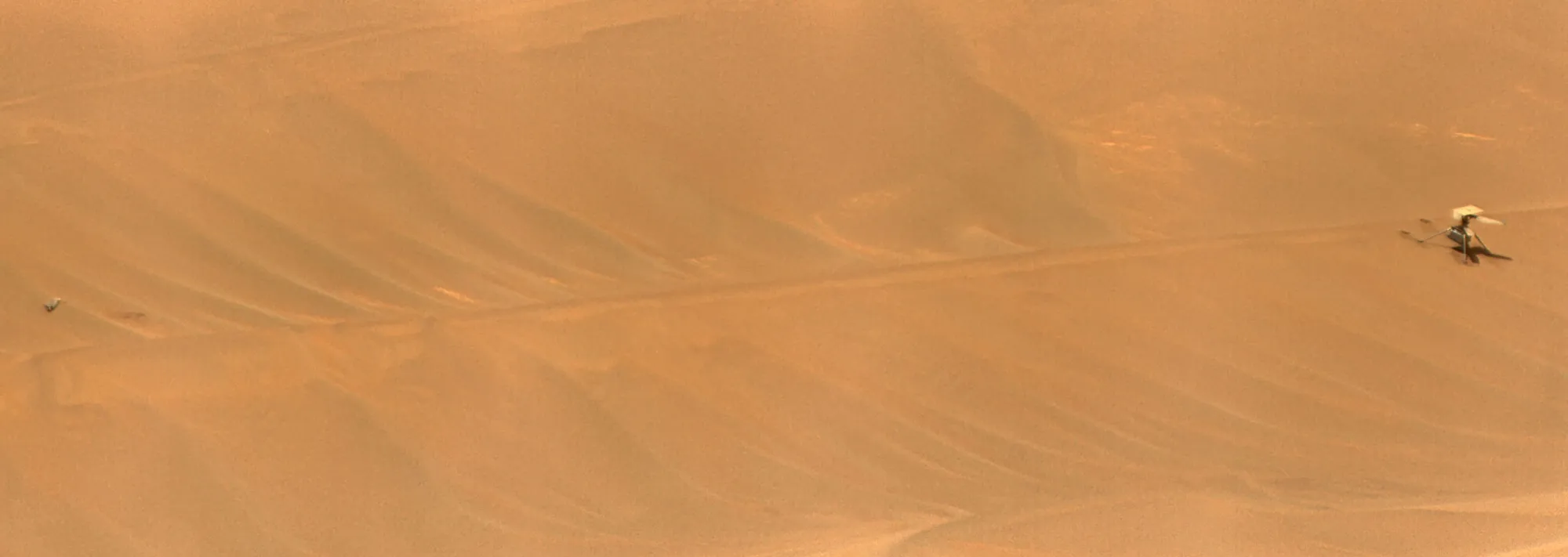
Ingenuity vastly exceeded expectations, going on to complete 72 flights over nearly three years, covering roughly 17 kilometres and serving as an aerial scout for the Perseverance team. Its mission concluded on January 25, 2024, after its final flight resulted in rotor blade damage during a hard landing. The helicopter remains upright at a site nicknamed Valinor Hills in Jezero Crater's Neretva Vallis.
Mission Timeline
- Jul 30, 2020Launch from Cape Canaveral Space Launch Complex 41.
- Feb 18, 2021Landing in Jezero Crater, using the same entry, descent, and landing sequence pioneered by Curiosity.
- Apr 19, 2021Ingenuity completes the first powered, controlled flight on another planet.
- 2022–2023Perseverance explores and climbs the ancient river delta inside Jezero Crater, collecting a series of rock core samples along the way.
- Jan 25, 2024Ingenuity's mission concludes after 72 flights, following rotor damage on its final landing.
- 2024–2025Perseverance ascends and explores the western rim of Jezero Crater.
- Feb 2026NASA activates Mars Global Localization, letting Perseverance determine its own precise position on Mars autonomously, without waiting for instructions from Earth.
Frequently Asked Questions
Sources
- Mars 2020 Mission Overviewmars.nasa.gov
- Mission Science Objectivesmars.nasa.gov
- Perseverance Science Instrumentsmars.nasa.gov
- Ingenuity Mission Endsjpl.nasa.gov
- Mars Global Localizationjpl.nasa.gov
- Perseverance Rover Location Mapscience.nasa.gov
Explore More
See Perseverance moving live
Watch its real driving trail on an interactive 3D Mars globe, alongside Curiosity and active orbiters.
Open the Mars Tracker