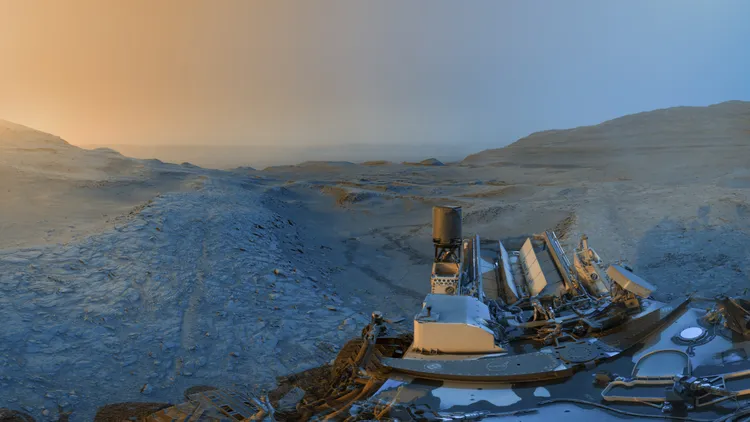
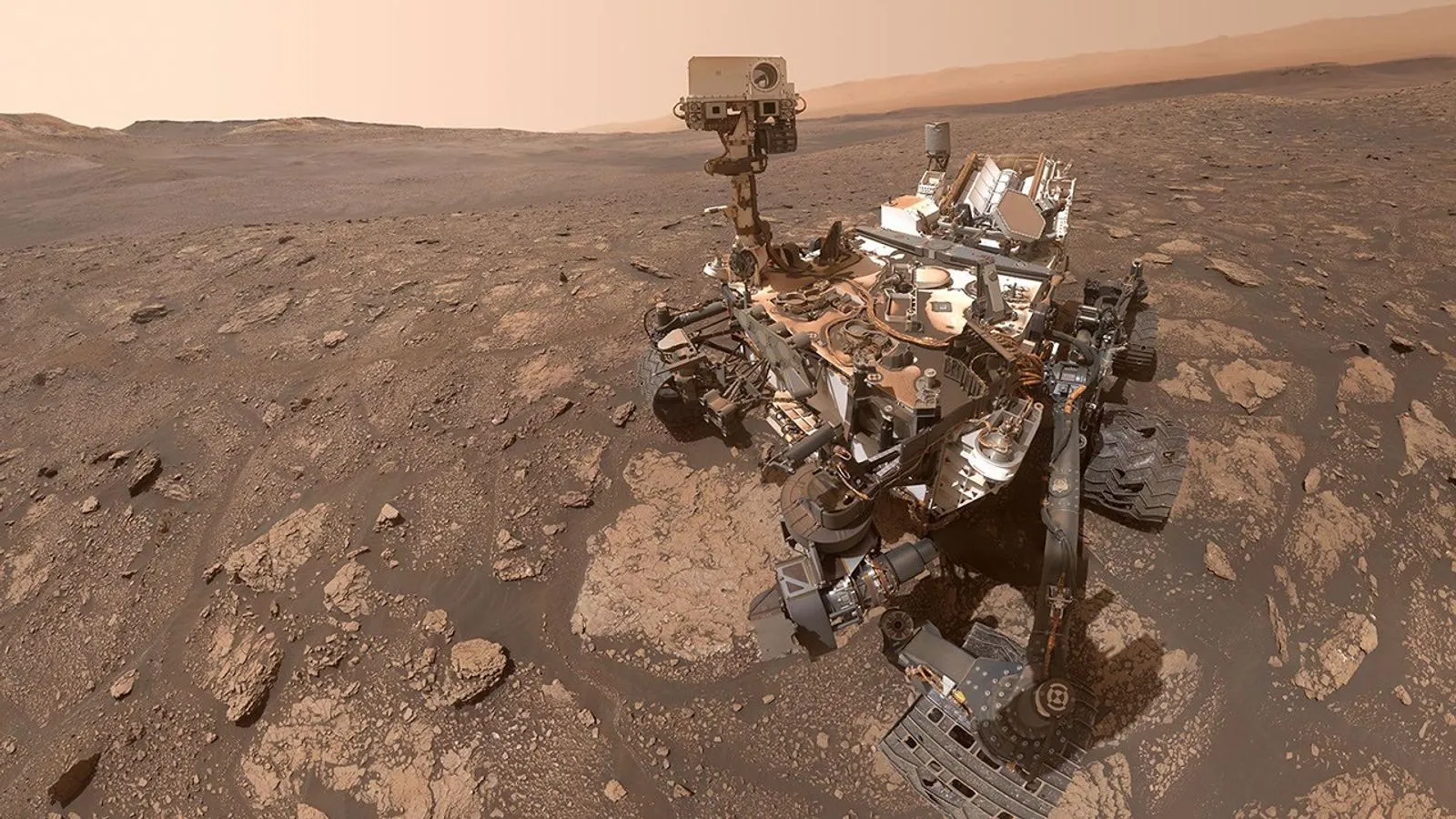
NASA's Curiosity rover has been exploring Gale Crater on Mars since August 2012, investigating whether the region ever had environmental conditions able to support microbial life. Part of the Mars Science Laboratory mission, it was the largest and most capable rover ever sent to Mars until Perseverance arrived nearly a decade later.
This page tracks Curiosity's real position and distance driven using NASA's own published telemetry — the same data rendered live on SatFleet Live's interactive Mars map, alongside the rover's complete real driving trail.
Quick Facts
| Mission name | Mars Science Laboratory (MSL) |
| Agency | NASA / Jet Propulsion Laboratory (JPL) |
| Launch | November 26, 2011, from Cape Canaveral Space Launch Complex 41 |
| Landing | August 6, 2012 (UTC), Gale Crater, Mars |
| Landing site | Gale Crater — a 154-km-wide impact basin with the layered Mount Sharp at its centre |
| Dimensions | Approx. 3 m long, 2.7 m wide, 2.2 m tall |
| Power source | Multi-Mission Radioisotope Thermoelectric Generator (MMRTG) |
| Mission status | Active, now in its 14th year of surface operations |
| Landing method | Sky crane — first used on Curiosity, later reused for Perseverance |
How This Live Data Works
The figures at the top of this page are not estimated or simulated. NASA publishes Curiosity's driving telemetry directly — including its position and cumulative distance driven — and SatFleet Live reads this data automatically to keep both this page and the interactive Mars map up to date.
On the Mars map, this same data is rendered as a real driving trail overlaid on true Mars surface imagery, alongside Perseverance, active orbiters, and the planet's moons, Phobos and Deimos.
Mission Objectives
Curiosity was sent to answer a single central question: did Gale Crater ever have environmental conditions capable of supporting small life forms called microbes? Within its first year, the rover found the answer at a site called Yellowknife Bay, where clay-bearing sedimentary rocks revealed evidence of an ancient lakebed with fresh water, the key chemical ingredients for life, and a chemical source of energy microbes could have used.
With that question answered, Curiosity's ongoing mission is to study the rock record preserved in Mount Sharp's layers, each of which represents a different chapter in how Mars' environment and climate changed over time — tracing the planet's transition from a wetter past to the cold, dry world it is today.
The Ten Science Instruments
Cameras
Spectrometers
Radiation & Environment
Climbing Mount Sharp
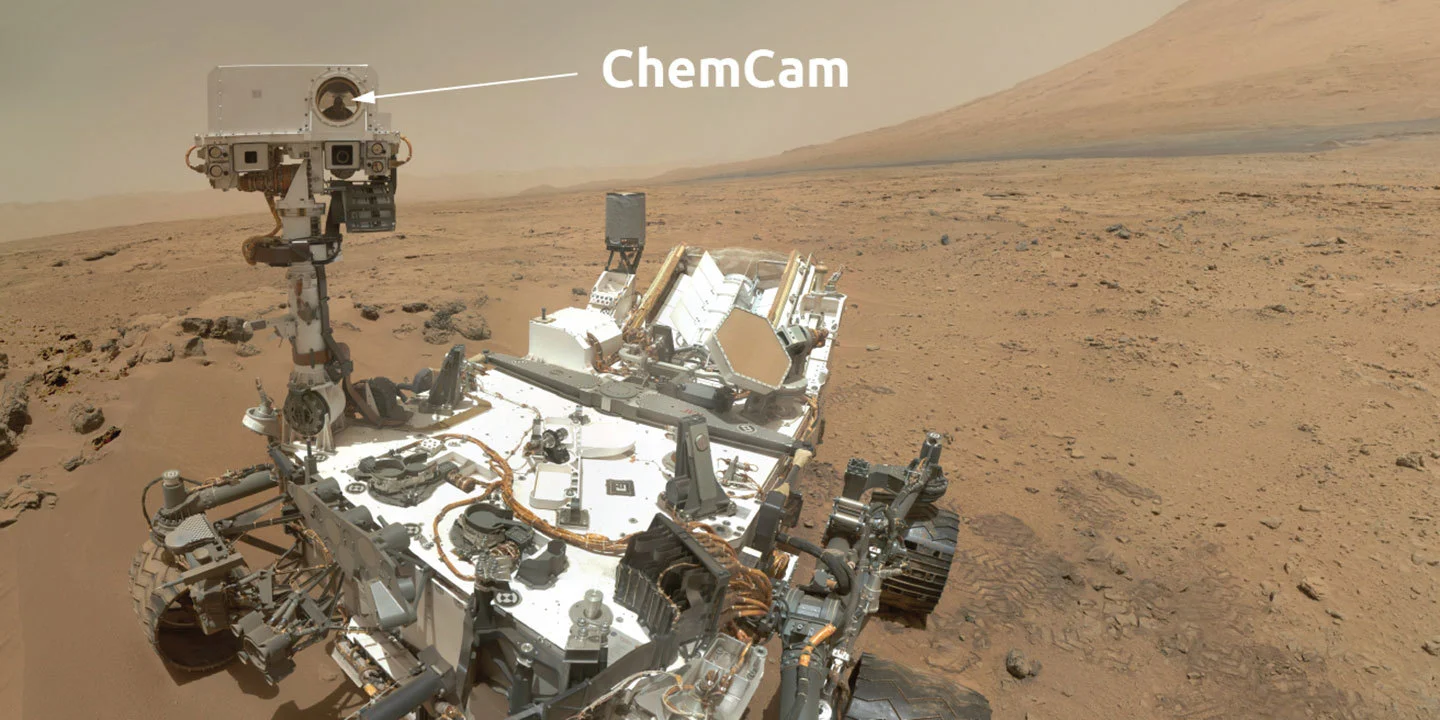
Since reaching the base of Mount Sharp in 2014, Curiosity has been steadily climbing through its lower layers, each one a snapshot of a different period in Mars' environmental history. On August 26, 2026, in its 14th year on Mars, the rover reached a new milestone: a cumulative elevation gain of 1 kilometre since it began the ascent — the highest point of its journey so far.
Along the way, Curiosity's instruments have made some of the mission's most significant discoveries, including some of the largest organic compounds ever detected on Mars, found in a drilled rock sample and hypothesized by researchers to be fragments of fatty acids preserved in ancient mudstone — evidence that complex carbon chemistry was at work on Mars billions of years ago.
Mission Timeline
- Nov 26, 2011Launch from Cape Canaveral Space Launch Complex 41.
- Aug 6, 2012Landing in Gale Crater using the sky crane maneuver, a first for Mars exploration.
- 2013Discovers evidence of an ancient freshwater lakebed at Yellowknife Bay, fulfilling the mission's core science goal.
- 2014Reaches the base of Mount Sharp and begins its ongoing ascent through the mountain's layers.
- 2018SAM instrument detects seasonal variations in atmospheric methane and organic molecules preserved in ancient mudstone.
- Feb 2026Researchers confirm some of the largest organic compounds ever found on Mars in a Curiosity-drilled sample.
- Aug 26, 2026Curiosity marks 1 kilometre of cumulative elevation gain climbing Mount Sharp, in its 14th year on Mars.
Frequently Asked Questions
Sources
- MSL / Curiosity Mission Overviewmars.nasa.gov
- Curiosity Arrives at Mount Sharpmars.nasa.gov
- A Guide to Gale Cratermars.nasa.gov
- ChemCam Instrument Overviewmars.nasa.gov
- Mars Science Laboratory: Curiosity Rovermars.nasa.gov
Explore More
See Curiosity moving live
Watch its real driving trail on an interactive 3D Mars globe, alongside Perseverance and active orbiters.
Open the Mars Tracker