
Ingenuity was a small technology demonstration helicopter carried to Mars by NASA's Perseverance rover, tucked against its belly for the journey. Designed for at most five experimental flights, it ended up making 72, becoming one of the most successful technology demonstrations in NASA's history before its mission concluded in January 2024.
This page documents Ingenuity's full flight history and final landing, drawn entirely from NASA and JPL records. It flew alongside Perseverance, which you can follow live on SatFleet Live's interactive 3D Mars map.
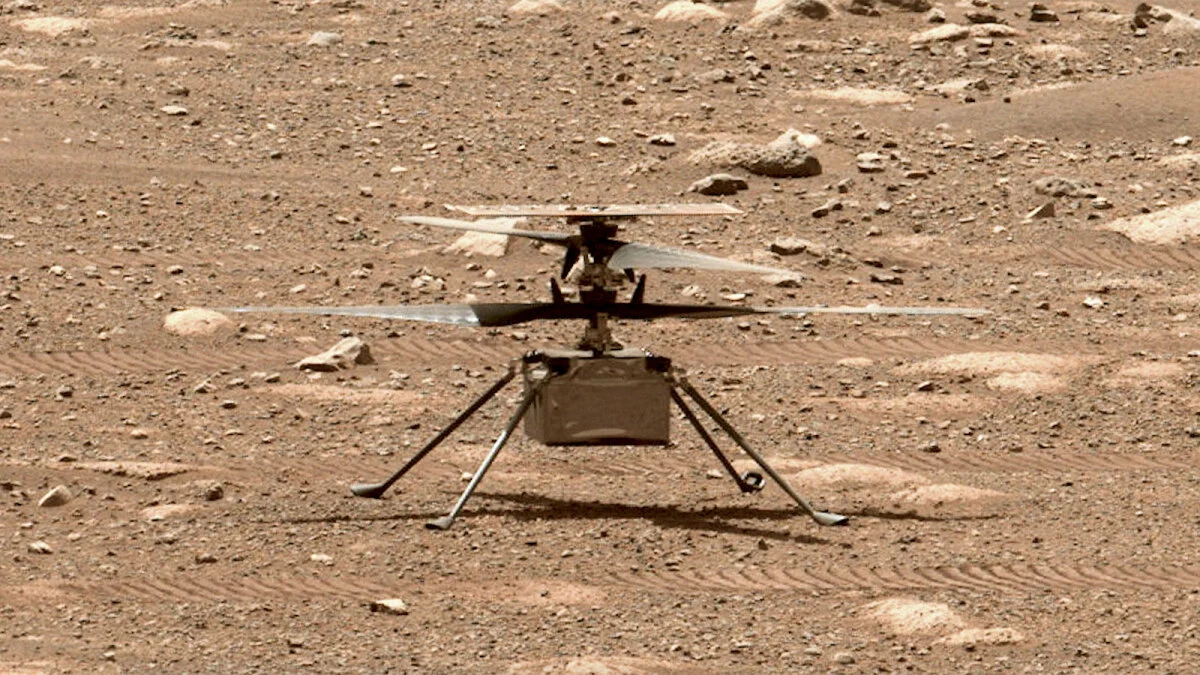
Quick Facts
| Full role | Technology demonstration, Mars 2020 mission |
| Agency | NASA / Jet Propulsion Laboratory (JPL) |
| Arrival on Mars | February 18, 2021, attached to Perseverance's belly |
| First flight | April 19, 2021 — first powered, controlled flight on another planet |
| Original goal | Up to 5 experimental flights over 30 days |
| Actual flights completed | 72, over nearly 3 years |
| Total distance flown | Approximately 17 kilometres |
| Mission end | January 25, 2024, following rotor damage on Flight 72 |
| Final location | "Valinor Hills," Neretva Vallis, Jezero Crater |
The First Flight on Another World
On April 19, 2021, Ingenuity lifted off from the floor of Jezero Crater, hovered briefly, and landed again — becoming the first aircraft in history to achieve powered, controlled flight on a planet other than Earth. The achievement was widely compared to the Wright brothers' first flight at Kitty Hawk, a milestone in the history of flight itself, just performed on another world entirely.
Mars presented a uniquely difficult environment for flight: its atmosphere is only about 1% as dense as Earth's, meaning Ingenuity's rotors had to spin far faster than any helicopter on Earth to generate enough lift.
Real footage of Ingenuity's first flight, captured by Perseverance. Credit: NASA/JPL-Caltech.
72 Flights, Far Beyond Expectations
Ingenuity was never meant to last this long. Its original mission was a narrow technology demonstration: prove that powered flight was possible on Mars, in as few as five flights over 30 days. After succeeding almost immediately, NASA extended its mission, and Ingenuity took on a new role as an aerial scout for the Perseverance team, surveying terrain ahead of the rover and helping plan safe, efficient driving routes.
Over the following years, Ingenuity flew 72 times, covering roughly 17 kilometres and accumulating over two hours of total flight time — figures that would have sounded implausible to the team that built a 30-day experiment.
The Final Flight
Ingenuity's 72nd flight, on January 18, 2024, was planned as a short vertical hop to help the team determine its location after an emergency landing on the previous flight. Data showed the helicopter reached about 12 metres of altitude and hovered briefly before descending — but contact was lost roughly 1 metre above the surface. Communications were restored the next day through Perseverance, which serves as Ingenuity's relay station.
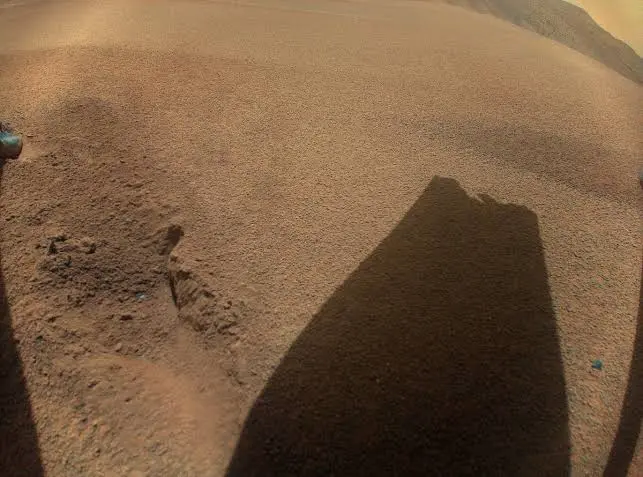
Imagery sent back days later revealed the cause: one or more rotor blades had been damaged during touchdown, leaving the helicopter unable to fly. NASA's subsequent investigation — the first aircraft accident investigation ever conducted on another world — concluded that Ingenuity's navigation system likely failed to gather enough reliable terrain data over unusually smooth, featureless ground, contributing to a harder-than-normal landing.
Legacy
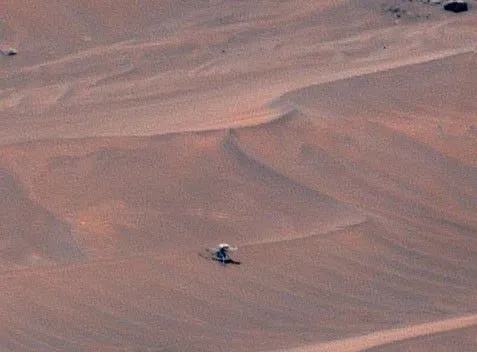
NASA officially concluded Ingenuity's mission on January 25, 2024. The helicopter remains upright at a site nicknamed Valinor Hills, in Jezero Crater's Neretva Vallis, unable to fly but still capable of periodic contact through Perseverance as long as the rover remains within range.
Findings from Ingenuity's accident investigation are expected to directly benefit the design of future Mars helicopters and other aircraft intended to fly on worlds beyond Earth — a legacy that extends well past its own flight log.
Frequently Asked Questions
Sources
- After Three Years on Mars, Ingenuity's Mission Endsjpl.nasa.gov
- Ingenuity Team Says Goodbye ... for Nowjpl.nasa.gov
- First Aircraft Accident Investigation on Another Worldjpl.nasa.gov
- Farewell to Our Flying Friendscience.nasa.gov
Explore More
Follow the mission Ingenuity supported
See Perseverance's live position and real driving trail on an interactive 3D Mars globe.
Open the Mars Tracker